


Tiaras
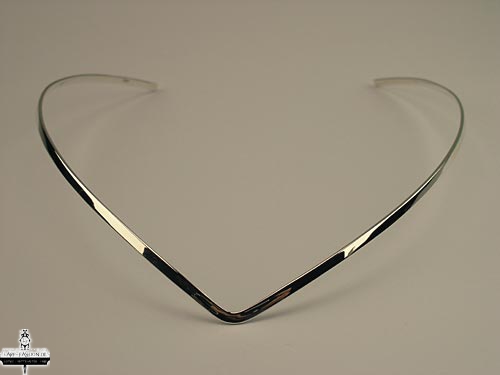
Medieval Silver Tiara
Perfect for injecting elements of distinct Medieval elegance and sophistication into your Larp wardrobe, this Medieval Silver Tiara is sure to become a welcomed addition to your accessory collection. Historically inspired, this beautifully crafted tiara will open your eyes to traditional Medieval design that will complement and enhance any Larp, Renaissance, Medieval or Fantasy costume. Crafted to the highest possible standard, this silver coated tiara is the ultimate accessory for any Medieval princess.
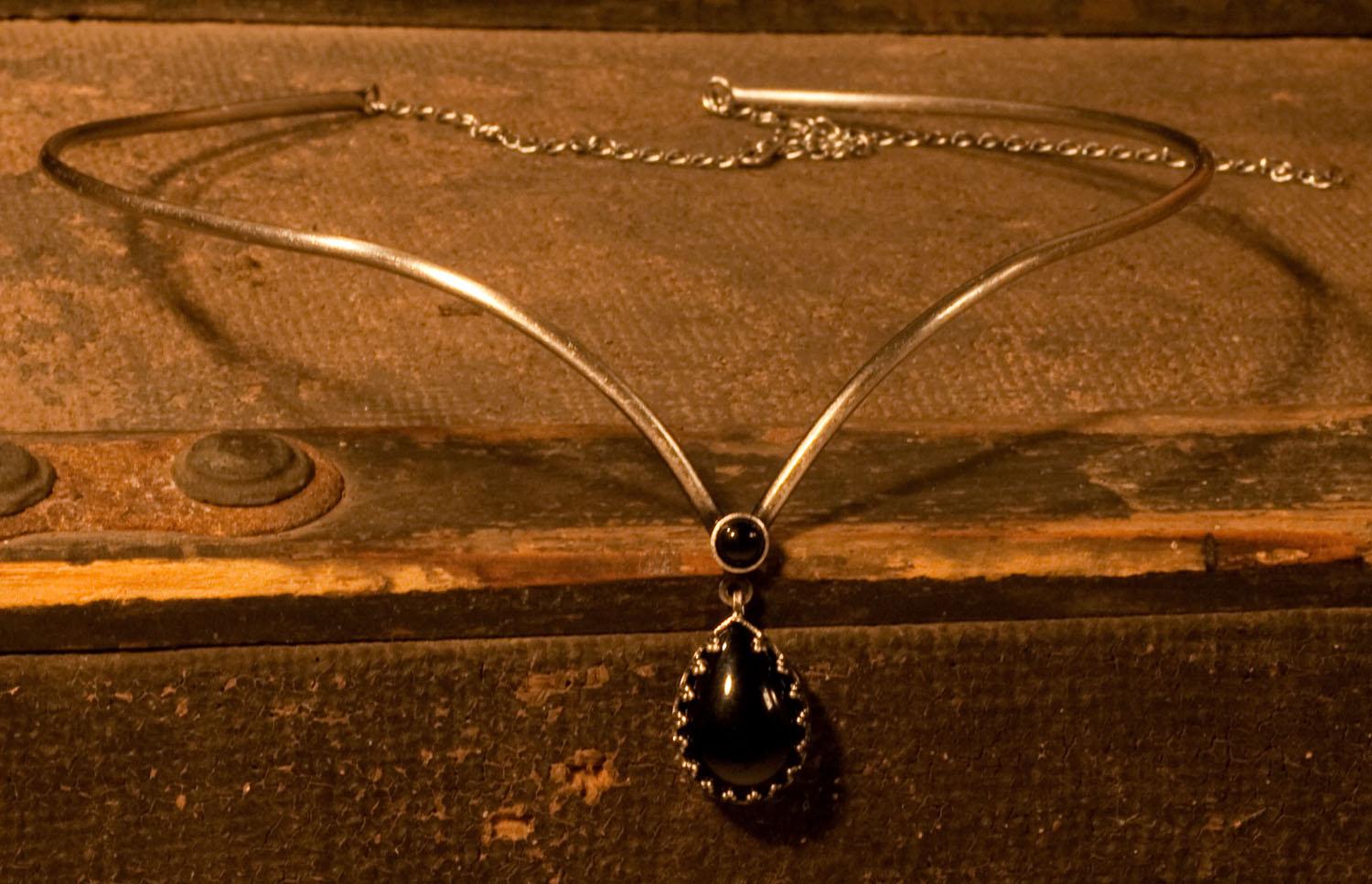
Tiara Tear of Awareness
The Tear of Awareness Tiara is a must have magical item for Wizards, Elves and more. This medieval style tiara is perfect for inclusion in treasure, tournament prizes or loot from quests. Made from lead-free tombac in an antique-silver style, the tiara is perfect for bringing some real colour to any LARP character or complementing any medieval outfit for an event or occasions. The tiara is decorated with high-quality glass stones which are available in several colours including black, red, green and dark blue. The tiara fits any head by fastening with an adjustable cord at the back.
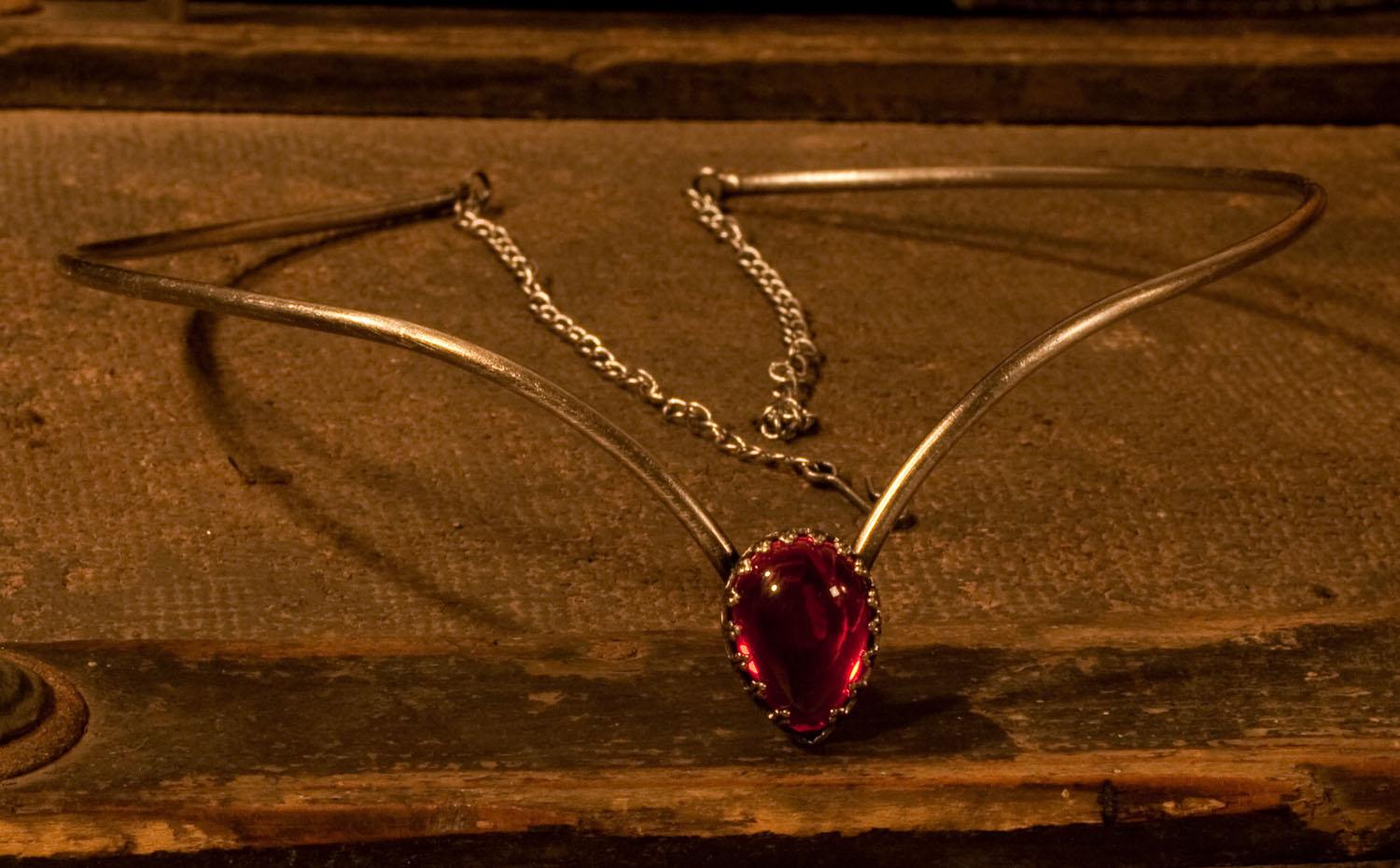
Tiara Drop of Simplicity
It may be called the drop of simplicity but this elegant tiara is anything but simple. Made from a lead-free tombac, it's a piece of jewellery that is perfect for gothic characters such as witches and vampires. The tiara is available in silver or a more antiquated version which is ideal for characters which are thousands of years old. The tiara is decorated with high quality glass stones which can come in several colours including black, red, dark blue and purple. The tiaras are fastened with an adjustable chord which makes them ideal for any head size.
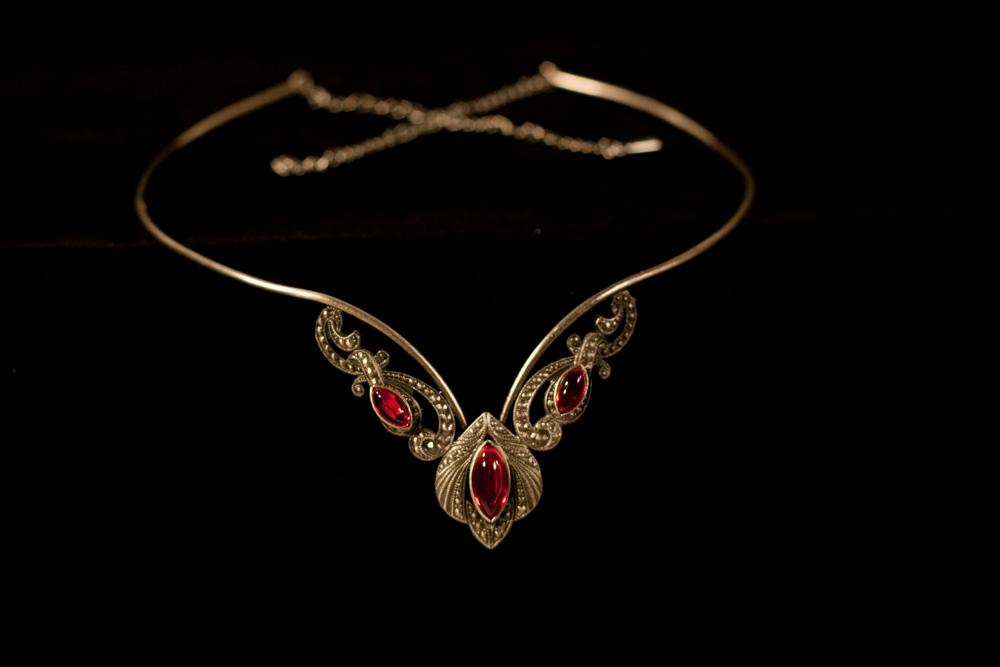
Tiara Goddess of Sublimity
Embracing distinct design elements that have become synonymous with a number of ancient cultures, this beautifully crafted Tiara Goddess of Sublimity will introduce your Medieval accessory collection to artfully crafted design that is sure to turn heads, wherever you go. Ideal for complementing and enhancing a wide range of Renaissance, Fantasy, Larp and Medieval costumes, this authentic Medieval tiara is made from lead free tombac and has been decorated with high-class glass stones. With its antique silver finish and intricate detailing, this Tiara is sure to command attention, whether you're attending a Medieval banquet, wedding or festival.
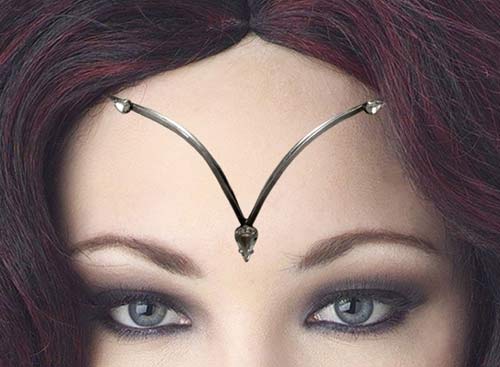
Tiara Arc of Wrath
Appropriate jewellery for gothics, medieval people, witches and fantasy. Wonderfully worked out, made of lead free tombac, either silvery or antiquely silvery, decorated with high-class glass stonesAll tiaras can be closed by an adjustable cord, fitting any head
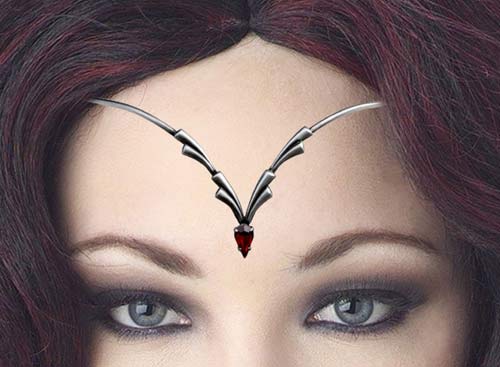
Tiara Arc of Sanity
With its air of mystery and enchantment, this Arc of Sanity Tiara is the ideal accessory for a Gothic, Medieval, witch, or fantasy look. Beautifully crafted from the finest lead free tombac, this captivating piece of Medieval jewellery is adorned with premium glass stones that glisten and dance under the light. Available in both burgundy and crystal, this gothic tiara is secured with an adjustable cord, meaning it will fit any head perfectly.
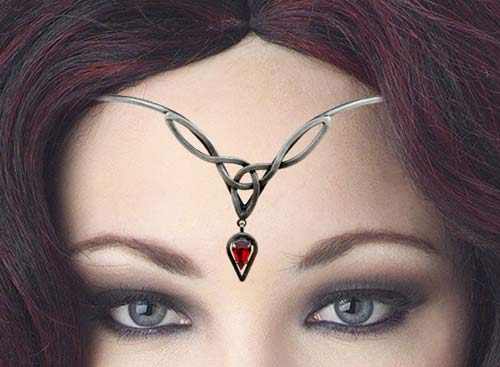
Tiara Triquetta
A gothic style tiara that is ideal for characters in a LARP scenario, a themed event or your gothic style. The tiara is perfect for Vampyres, Witches and other gothic characters to show their affiliation to the dark arts of the fantasy world. It features a knot-style design with a high quality glass stone dangling from the lower point just between your eyes. The stone is available in several colours including black, green and burgundy and the tiara is made from lead-free tombac. It is fastened with an adjustable cord making it fit any head.
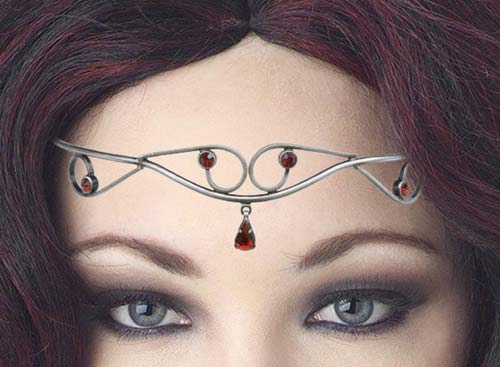
Tiara Elven Arcs
Channel the power of the Elves with this Elven arc tiara which is perfect for gothic or magic characters. The tiara features an arc style made from lead free tombac with swirls and arcs to create an elegant piece of jewellery which will look at home on the head of a witch or vampire alike. The tiara is decorated with high quality glass stones throughout the design with different stones available to suit your style or align with your abilities. The tiara fastens with an adjustable cord around the back ensuring they fit any head size.
Your medieval headdress for fantasy events and more
 For a mage's or elf's garb, you need suitable clothing, i.e. a robe or at least a long cloak. This also includes an elven headdress, because in fantasy everything is possible - including infinitely precious-looking accessories. A headdress rounds off a carefully designed costume and makes it possible to portray the character even better. One or more sparkling stones on the forehead give the elf or fairy of fantasy a mysterious look and emphasise the beauty of their face. Take a look around our shop and find the right jewellery and all the accessories you need for your costume or garb. Save what you like on the watch list so that you can compare it later at your leisure. We are happy that you are here.
The tiara - universally combinable
The tiara is an ideal headdress for ladies, which is worn on the LARP as well as in the Gothic scene. It is the perfect complement to a well-made make-up. You can achieve great effects by combining the colour of the tiara's stones with lipstick of the same colour. Depending on your taste, the beautiful jewellery can consist of a narrow hoop made of silver or of small, finely chiselled ornaments. This type of headdress for ladies, elves and fairies adapts to any head shape as it is closed at the back of the head with an adjustable chain.
The great variety in the online-shop at LARP-fashion.co.uk
 We have many different headdress variants for ladies, fairies and elves on offer, so that you can also find the right jewellery for yourself as a princess. Choose a simple tiara to decorate your forehead or opt for a headdress with filigree details. You will find many options in our shop - from the simple tiara from the Middle Ages in antique silver to the stone-studded headdress for the fairies and elves of the fantasy scene. Of course, we will be happy to provide you with any information you may need before you choose. Here we have compiled all kinds of information for you on headdresses in the Middle Ages, in case you are also interested in the origin of the precious tiaras and other jewels.
Headdress - Middle Ages, Antiquity and Fantasy
Headdresses in the Middle Ages were reserved for highly placed personalities. The nobles had to have a fortune at their disposal to have jewellery made at all. They also needed special occasions to wear such precious items, which were really impractical for the strenuous Middle Ages. For one could not move around very well with the headdress and other jewellery. Dignified striding and implied bows, but that was about it. Moreover, at least in the early Middle Ages, the art of smithing and sewing was not quite so good. Because even for the hennin or the burgundy bonnet, you needed real experts. The hennin was a cone-shaped headdress made of velvet attached to wire or whalebone. The hennin could be up to three feet high and sometimes even had an additional veil and horns protruding from the sides. Even this hennin could only be made with extreme effort. It was completely unwearable in everyday life but highly modern at the time. How much more did this apply to the diadem, the tiara or even a crown? The crown, as a headdress in one form or another, had worldwide status. It literally elevated its wearer and raised him or her above the crowd. The normal citizens in the Middle Ages were not supposed to adorn their heads, but at most to cover them humbly or demurely. Even for the beret, one had better be of nobility. For the peasant, the most that remained was a cap made of felt against the blazing sun.
The crown as a headdress for rulers in the Middle Ages
 If a crown from the early Middle Ages has survived or been handed down to us in a picture, it does indeed look a bit clumsy. At that time, it consisted rather of a hoop made of iron, bronze, silver or sheet gold that could be pressed onto the head and hair. Only in the high and late Middle Ages did the crown slowly develop into the kind of valuable showpiece that we can still admire today in English, Persian, Indian or other collections. The "Iron Crown" of the Lombards, for example, is considered a fascinating piece of jewellery made of gold, silver and precious stones. It was first mentioned in 1159. Nevertheless, even this crown was still shaped like a hoop.
The simple hoop developed into the open crown and then the crown of prongs, which was admittedly built higher and higher. The crown of the wife of Emperor Charles IV, "Korona Sredzka", from about 1350 is a ravishing example of the high art of the goldsmiths in the Middle Ages. The serrated crown from the Middle Ages was subsequently replaced by the crown closed at the top, such as the imperial crown of Rudolf II. However, this was not created until 1602, when the Middle Ages were over. In fact, however, the crown was a further development of the diadem, which had been used as a headdress since antiquity and even earlier.
The diadem or coronet
 Before the diadem showed the first signs of a crown in the year 325 by Constantine the Great, it had already had a history of almost 2000 years as a headdress. The ancient Persians and Egyptians had already worn the diadem in 1500 BC. They also used gold and silver for it. Later, various variations emerged, e.g. head bands decorated with golden flowers or gazelle heads. The term diadem is Greek and means the surrounding. And that is exactly what the Greeks and Persians did with a diadem in the beginning. Among the Persians, it was wrapped around the turban as a cloth and was supposed to decorate it in a special way. Among the Greeks and later the Romans, the diadem was regarded as a sign of royal dignity and was also called the royal bandage. Greek goddesses and gods were depicted with fixed diadems, which in the representation were slipped around the head as hoops.
The winners of the Olympic Games were also allowed to wear such a cloth as a kind of ruler of the sporting competitors, from which the metal laurel wreath later developed. In the Middle Ages, the tiara was only partially widespread; it was worn more in Byzantium and Italy. The diadem also served as an ornament for angels in artistic representation. In central and northern Europe, the diadem found its equivalent in the schapel, a kind of circlet or chaplet. The schapel was the most popular headdress in the Gothic period between the 12th and 16th centuries. The schapel was a wreath of leaves or artificial flowers with which young men and maidens adorned themselves. Later, the chaplet came into fashion among the high classes, made of sheet silver or even sheet gold, and was then worn like a kind of crown.
The tiara - Middle Ages with the Pope
 In English, the word tiara is used for the diadem as well. And we know the tiara as the name for the headdress from the LARP, fantasy and gothic scenes. But when you get right down to it, the term tiara is originally used for the former papal crown - and for the crowns of the Assyrian and Persian rulers. These wore conical hats covered with a gold band. And thus the original tiara is almost reminiscent of the hennin as a headdress for high-ranking ladies, which we mentioned at the beginning. If you look at the headdress that is called a tiara today, it is usually a kind of graceful and dainty headband decorated with pearls, stones or jewelled chains. Such dangling pearls can be found in many cultures, like noble hair slides, hair beads or similar head jewellery.
Even the Vikings used such headdresses. But whether Vikings, Africans, Arabs, Byzantines or Italians: the fine and noble headdress could only be worn at high festivals or marriages. On the one hand, such precious objects had to be carefully guarded. On the other hand, as w said, a headdress required extremely careful or dignified movements so as not to jeopardise its fit on the head.